Ohio's largest living history destination offering guests experiences
rich in history, hospitality, creativity and fun!


Wednesday, March 5, 2014

Ask the Expert – A New Blog Series in 2014!

As part of our new blog series for this year, we plan to introduce you to many of the experts we have working at Sauder Village and also give you the opportunity to ask them a question or two! From gardening, crafts and preserving your artifacts to education and historic cooking – we hope you enjoy meeting some of our talented staff and take time to ask them a question. What a great way to learn something new!

Since there’s snow on the ground and we’re all dreaming of spring we’ve decided to start with a segment about gardening. We hope you enjoy meeting our Grounds Supervisor, Susan Burkhart.

If you have questions about anything garden-related please post a comment below, on our Facebook page or even send an e-mail to our Marketing Department at kmkrieger@saudervillage.org. Susan will answer as many questions as she can in an upcoming article. Thanks for helping us to share information that you are most interested in!


Meet Susan Burkhart

Title: Grounds Supervisor. Susan has worked at Sauder Village for 18 years

Main Responsibilities: Susan is responsible for taking care of all the landscaping at Sauder Village – including all historic gardens.

Favorite Part of Job: “I love my job!” Susan shared. “There are always a variety of things to do. My responsibilities change with the seasons – from planning gardens in the winter to planting flower beds, harvesting vegetables and decorating for Christmas! This time of the year it is fun to dream about the gardens. I love thinking of new ways to share our story and new garden-themed activities that guests can get involved with.”


Favorite Flower or Vegetable: “I love the variety of squash and pumpkins. It is so much fun to plant the seeds, watch them grow and as the leaves die back see the bountiful harvest,” Susan shared. “My favorite flowers are the “Proven Winners” variety of flowers – they are a step up from the standard variety and make such a statement in the barrels and gardens we have here at Sauder Village.”


Favorite Garden: “I love the Homestead Garden. It is large enough to have a variety of flowers and vegetables,” Susan shared. “The 1900s time frame allows for a very interesting garden – trains were starting to come through and that brought new varieties of seeds for families to plant (before that they just brought seeds with them). During this time period the ladies in the house also had more ‘leisurely time’ and could enjoy more flowers. They even dried them to use for decorating for Christmas!”


Anything New Planned this Season? “We want to do more with the gardens at Little Pioneers Homestead this year,” Susan noted. “We are looking at some changes to that garden area that will allow kids to get more involved – kind of a face-lift for Little Pioneers Homestead Garden.”

Some Gardening Tips from Susan:
- Try starting seeds inside during the winter, but start out simple.
- Take time now to plan your garden, do some research and order seeds. Start dreaming about what you want to have this summer!
- If you want to learn about heirloom varieties do research. Some great websites include:
     Seed Savers Exchange
     Sand Hill Preservation Center
     Baker Creek Heirloom Seeds

Other Notes of Interest: We usually have some plants available for sale in the spring – heirloom tomato varieties, Malabar Spinach, Ground Cherries and more! We also have produce for sale in the Fall – when there is extra. First goal is to use the produce in our foodways program and next we’ll have for sale in the Herb Shop.

Greatest Accomplishment: Susan has enjoyed having some of the Sauder Village gardens recognized in the media – both newspaper and magazine articles throughout the region.

Hobbies: In her spare time Susan enjoys kayaking, traveling, relaxing at the lake with her family and spending time with her kids at their sporting events.

Wednesday, February 19, 2014

The Titanic Exhibit at Imagination Station – Sauder Village Helps Tell the Story


Early this month our Curator of Collections took artifacts to Toledo to be used as part of the Titanic Exhibit at Imagination Station. As a participating sponsor, we are exhibiting a variety of trunks, a fainting couch, table, tea service, table cloth and clothing. The Titanic Exhibit opened last weekend and runs through June 15, 2014.

“Imagination Station was looking for items that would represent our society in 1912 when the Titanic sank,” shared Tracie Evans, Curator of Collections. “They want guests to see not just the movie of that time period, but how similar it was to life in Northwest Ohio.”


The Maumee Valley Historical Society has provided Imagination Station with period clothing representing upper class communities/first class passengers and we helped complete that display with furniture and tea service. The curators at Imagination Station also wanted people to see what the working class community was wearing. To help tell that story we shared women’s dresses, a man’s suit, shawls, wraps and coats – similar to what may have been worn by second or third class passengers on the Titanic. We also took trunks to Imagination Station to help tell the story of travel during the early 1900s. Two of the trunks were manufactured in Ohio and they represent the typical style of trunks used by the various passengers on the ship.


“Our involvement with this special exhibit is a great way for people to see that our collections represent not just life in Northwest Ohio, but how connected our ancestors were to a national and international story,” Tracie added. “The Titanic event happened thousands of miles away but it still reverberated in our local communities. There were people who lived in this area who were on board or had family members on the ship and were touched by this tragedy.”

In addition to having some artifacts from our collection on display, some Sauder Village staff members will also be presenting special programs this spring at Imagination Station. Some of the programs will focus on preservation of artifacts, telegraphy, and tea time. Watch for more details on our Sauder Village website.

For more details about the Titanic Exhibit at Imagination Station visit their website


Friday, April 19, 2013

Knitted Presidents Exhibit at Sauder Village


Sauder Village will be hosting a special traveling exhibit of knitted Presidents in the Museum Building this season. The exhibit includes all forty-three men who have been President of the United States. These three-dimensional figures are surprisingly life-like with period clothing and include unique elements that represent their work, hobbies, events and activities.

Created by the Knotty Knitters Club of California, this exhibit has won first prize at the California State Fair and had numerous television appearances. Most recently the Knitted Presidents Exhibit has been on display in Chicago.


Be sure to stop by the Museum Building this season to see this creative exhibit and learn more about our the forty-three men who have been President of the United States!  


Wednesday, March 6, 2013

Sauder Village Events - Win Symphony Tickets!

With Spring just around the corner, we are anxiously awaiting the opening of the Historic Village. Opening Day also means the start of a season filled with great events. Special events have been a cornerstone of the Sauder Village experience for many years. From craft events like quilting and rug hooking to concerts, base ball tournaments and family activities - Sauder Village offers something for everyone! Click here for more details about all the events planned for 2013!

An always-popular special event is the annual Toledo Symphony Concert. This is the 24th year this highly respected orchestra has performed in beautiful Founder’s Hall. This year’s concert will be held on Thursday, March 14 at 7:30 p.m.  The program includes a wonderful mix of classical music, “Americana” waltzes, jazz and other traditional American music. Some highlights of the Archbold program include Symphony No. 32 by Mozart, Roses From the South Waltz by Strauss, Three Spirituals by Hailstork and The Girl I Left Behind Me arranged by Anderson. Purchase your tickets by calling 800.590.9755 or stop by the Welcome Center at Sauder Village. General admission tickets are $15 in advance and $18 at the door.

Enter our contest to  win two free tickets to this evening concert!
To enter the contest just log in below with your e-mail address or via Facebook. We will contact the winner via e-mail. Thanks for entering and good luck!


a Rafflecopter giveaway

Wednesday, February 20, 2013

Homemade Noodles . . . Give it a Try!

Have you ever watched our costumed guides making noodles in the Eicher Cabin or Witmer-Roth home and said, "I should really try that sometime!" Well perhaps this short blog post will inspire you!  Winter is a great time to make homemade noodles that you can use in a pot of soup on a cold, snowy day! Almost every farm woman had her own recipe for making noodles. This is one often used at Sauder Village.
HOMEMADE NOODLES
Ingredients: 
3/4 cup flour     pinch of salt
1 egg              water
   

Put ¾ cup flour and a pinch of salt (optional) in a container and make a well in the center of the mixture. Place 1 whole beaten egg OR 1 egg yolk beaten with ½ egg shell of water (about 1 T) in the well.


 Mix and add more flour as needed to form a dough ball that is not sticky.


Knead the dough for 5-7 minutes adding flour as needed to keep from sticking to surface. Cover with cloth and let dough rest for 20-30 minutes.


Divide dough in half and roll each half into a circle as large and thin as possible. Let the two circles dry, but not too dry as to crack.


You may cut the circles into quarters, stack them to make shorter noodles or roll like jellyrolls for longer ones. Using a sharp knife, cut the noodles to the desired width.


Spread noodles on towel to dry. It may take one day or longer to be dry to touch. (Noodles can be frozen after drying). Makes approximately ½ pound of noodles.

Tuesday, February 12, 2013

2013 Blog Updates . . . Teach, Inspire & Connect!

We have plans to use our Sauder Village blog to share even more valuable content throughout 2013. We hope to teach you something new, inspire you with stories about interesting people and get you excited about planning a visit and staying connected to all that is happening at Sauder Village.

Stay tuned! Our first “how-to” story with photos will be online soon!

Tuesday, August 14, 2012

Rug Hooking History

As we welcome rug hookers from across the country to our nationally-recognized Rug Hooking event this week, we realize there are still many people who don’t know much about this traditional art form. Here is just a bit of history to help you better understand this beautiful craft . . .

Rug hooking started in the mid 1800s in the Eastern United States. Like many crafts, rug hooking was started out of necessity. Colonial women used rags to make hand-hooked rugs to use on their floors in the summer and on beds in the winter.

The base of the rugs was made from the burlap sacks that the livestock feed came in and the fabric was any material that could be found including worn clothing, rags, old wool blankets or spun wool. Women hooked rugs in their homes to help pass the time during the hard cold winters.

To hook a rug, the rug hooker, with her right hand above the pattern and the cloth strips in her left hand underneath, pushes the hook down through the burlap. The hook catches the cloth strip and the rug hooker draws it back up to form a loop on the top of the burlap. Loops about half an inch long (length can vary) are formed to create the rug.

People eventually began selling hand-hooked rugs and cottage industries sprang up across the country. By the 1940s rug hooking had become a well-established hobby in the United States and Canada and its popularity continues to grow today. Hand-hooked rugs can be found in art galleries and museums throughout the world.

Again this year, rug hookers from across the country are gathering at Sauder Village to celebrate this traditional craft. This spectacular event includes workshops, lectures, vendors, demonstrations and a breath-taking exhibit in Founder’s Hall. We hope you'll visit the exhibit to see what all the excitement is about!

More detail about this special event can be found online at:
http://www.saudervillage.org/Creativity/rughooking.asp

Tuesday, July 24, 2012

School Days

It's hard to believe that school will soon be back in session for students throughout the region. Parents will be shopping for notebooks, pencils and new school clothes in preparation for another school year.

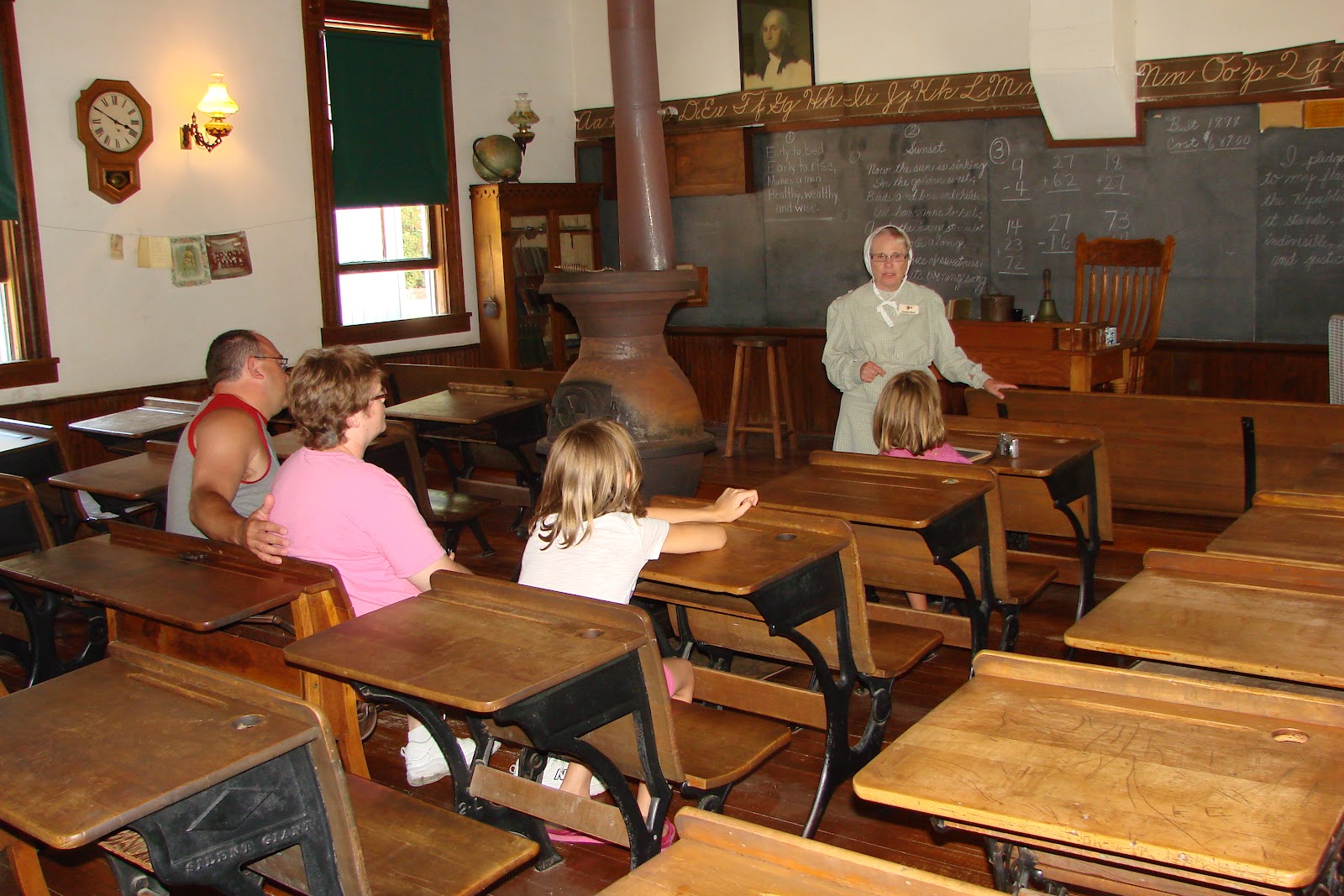
Have you ever wondered how our classrooms of today differ from those of 100 years ago? If so, we hope you'll take time to visit our District 16 School! Have a seat in desks, complete with ink wells, just as students did in their new school building in 1898.  Discover how the lives of today’s students and teachers differ from those of children years ago.  And, maybe you’ll learn of some aspects of one-room schools that still continue today.

The school that we call District 16 was originally called District #3, or Maple Grove School, in Chesterfield Township of Fulton County, Ohio.  The Maple Grove School was actually moved to Sauder Village from an area near the Ohio-Michigan border, north of the town of Wauseon.  It was used from 1898 to 1916. The first four buildings built in the Maple Grove District were log buildings much like the Log Schoolhouse in the Historic Village.  Our “District 16” schoolhouse was the seventh building built in that district.  After being used for 18 years, a new centralized school was built in 1916, and the time of one-room schoolhouses in Fulton County came to an end.

Interesting Facts About our Schools at Sauder Village (Log School and District 16 School):

In the 1830s, children attended school for short periods of time, sometimes for as little as 3 months during the winter!

In schools like our Log Schoolhouse, greased or oiled paper was often used over window openings due to the great expense of glass panes

One-room schools housed all the children in a district, often ranging from 6 to 20 years of age!

Our District 16 School was built in 1898 at a cost of $687.00.

Before being located by Erie Sauder, and restored at the Historic Village, the District 16 building was being used as a granary.

You will find 2 entry doors on the front of the District 16 School. It was specifically designed that way, with one entry for the girls to use, and one for the boys.

Friday, July 6, 2012

Food Preservation - Not Just for Grandma Anymore!

With grocery stores offering a variety of foods throughout the year and refrigerators and freezers in our homes - it might seem that canning and preserving foods would be a thing of the past. However, it seems food preservation is actually the new trend in homes across the country. Canning and preserving is not just for grandma anymore! In fact, some professionals in the canning business estimate that more than half of the canning population is under the age of 45!

Throughout the season guests visiting Historic Sauder Village can often see an assortment of vegetables being harvested from our gardens. Our costumed guides demonstrate a variety of food preservation techniques including drying, pickling, canning and even smoking meats. These demonstrations give our guests a unique look at the food preservation efforts of days gone by. The demonstrations vary with the season and time period in the Historic Village and recipes are often available for guests to take home.

Interested in giving food preservation a try but not sure where to start? Visit our website for some recipes and links to valuable food preservation resources!

http://www.saudervillage.org/historic_recipes/food_preservation.asp

Wednesday, June 27, 2012

The Erie Express Chugs Along…

Thanks to a group of friends, the Erie Express train will stay on track!

The Erie Express is a replica of an 1863 steam engine which played an important part in building America’s first transcontinental railroad.  Guests of all ages enjoy traveling back in time by riding the Erie Express through the historic timeline at Sauder Village, including Natives and Newcomers, Pioneer Settlement, and the 1910 Homestead area. 

Keeping the train running safely is a big task and our maintenance staff makes this a priority.  However, servicing the train is difficult and time-consuming.  Access to the underside of the train is necessary to maintain the equipment, requiring the over three-ton train to be lifted off the track. 

Unfortunately, this has caused our guests to experience interruptions in service.  No more!

Now, this disruption will be minimal as friends of Sauder Village contributed funds needed to build an underground service area that will enable our train to be inspected and serviced more efficiently. 

The underground service area will be built by the end of this season!  Thank you to everyone who has helped keep the Erie Express on track!

Even some of our youngest members made a donation
to this special project! Gifts to support the Erie Express
are still welcome. We are grateful to everyone who
has helped make this project possible!