Ohio's largest living history destination offering guests experiences
rich in history, hospitality, creativity and fun!


Showing posts with label history. Show all posts

Monday, July 28, 2014

Bicycles of Days Gone By at Sauder Village

From early high-wheelers and bone-shakers to the mountain bikes we see on trails today – bicycles have been part of the Midwest landscape for nearly 200 years! On August 2 & 3 the Ohio Wheelmen will celebrate the history of bicycles with their 20th Biennial Meet at Sauder Village. Nearly 80 wheelmen will share their love of cycling with antique bikes and accessories on display, demonstrations and a daily parade on the Village Green.

A Look at Bicycles of Days Gone By . . .
During the late nineteenth century, bicycles dramatically changed life throughout the Midwest. Horses and carriages were expensive to maintain in cities. There were only a few automobiles built and public transportation was often inadequate. The bicycle met the need for inexpensive, individual transportation – for business, deliveries, recreational riding and sport. What may seem a machine of modest and limited performance, in the 1890s the bicycle was recognized as a swift vehicle and fine machine.

Invented in 1817 by German Karl Drais, the first 2-wheeled tandem machine was called a Laufmaschine – a simple bike with a steerable front wheel. By the 1860s, the Velocipede was introduced. While this invention added cranks and pedals, its moderate-sized front wheel made it a little faster than walking and its wooden wheels and iron tires earned it the name “boneshaker.” Eventually the English persevered and introduced a bike with a larger front wheel to increase speed and smaller rear wheel for convenience. The “High-Wheel” bike also known as an “Ordinary” was born! While the “Ordinaries” were fun to ride, it was more for sport than transportation since rough roads often brought bad spills – one small bump and the rider went right over the handlebar, head down!

Finally, in 1885 the first Safety Bicycle was produced. Considerably safer than the high wheeler, the Safety Bike allowed the rider’s feet to always touch the ground and their head was only a few feet above the ground in case of a fall. Most accidents were limited to torn trousers, skinned knees and palms. The Safety Bike was the first vehicle that was practical and affordable for the common person and became a standard form of transportation in the late 1890s and early 1900s. Propelled by a chain running between two sprockets, the larger front sprocket at the pedals allowed the rear wheel to rotate faster than the rider pedaled. Early models had a wooden frame and hard rubber tires but later models were made of tubular steel and had inflatable pneumatic rubber tires – providing a more comfortable ride.

Today the bicycle is used for recreation, exercise and play in the United States. It is a primary source of transportation in much of the world. Join us to celebrate the great American tradition of bicycling. Check out the bicycle exhibit in our Museum Building and plan a visit on August 2 & 3 to meet the Wheelmen and see some amazing bicycles of “days gone by”.

Tuesday, April 1, 2014

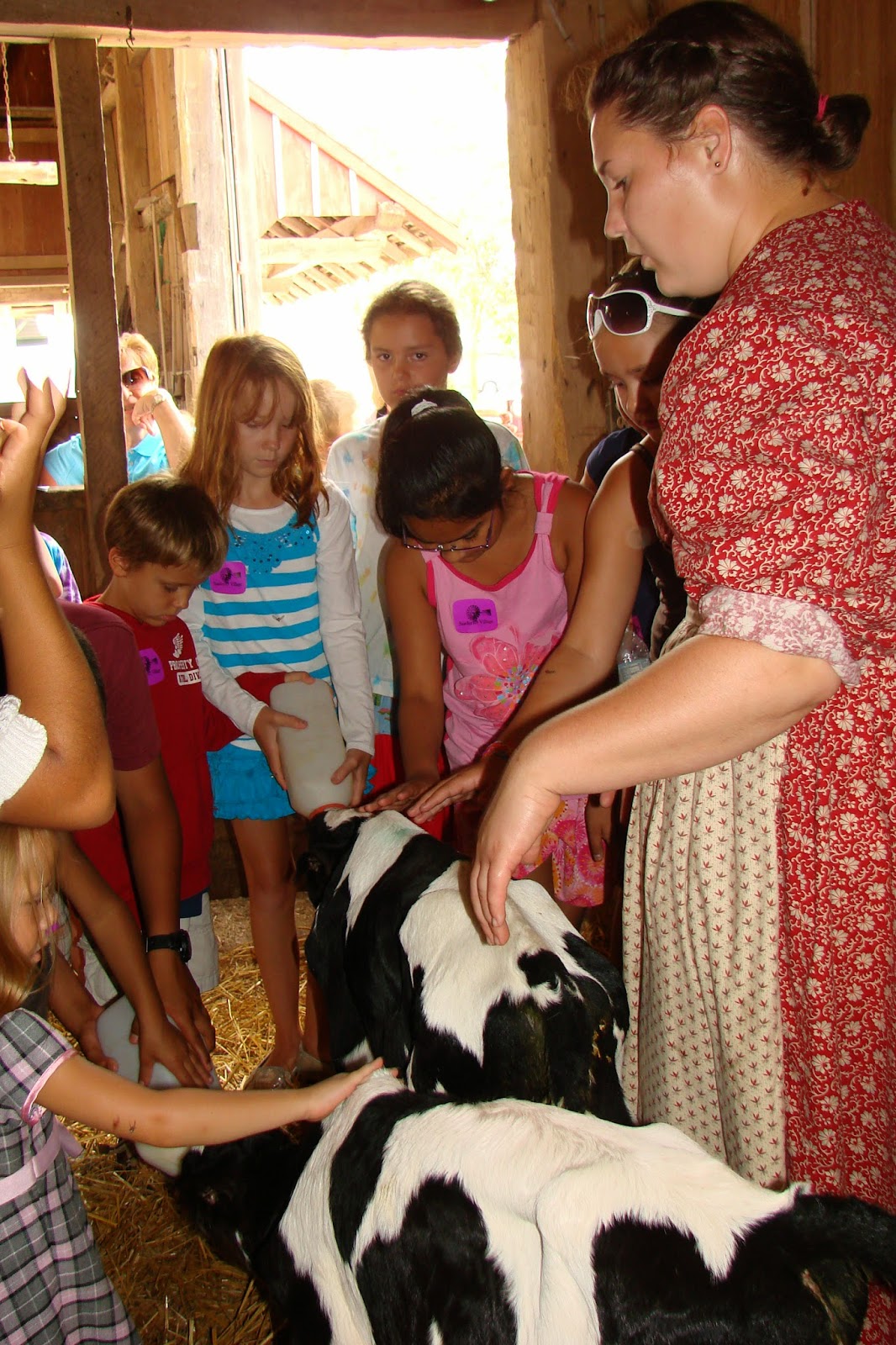
Ask The Expert - Meet Our Livestock Manager

As part of our blog series for this year, we're pleased to introduce you to another one of the many experts we have working at Sauder Village.  From gardening, crafts and preserving your artifacts to education, farming and historic cooking – we hope you enjoy meeting some of our talented staff and will take time to ask them a question or two. What a great way to learn something new!

We hope you enjoy meeting our Livestock Manager, Katie Frey. Please post any questions you have for Katie in the comment section below. Thanks!

Meet Katie Frey

Title:  Livestock Manager.  Katie Frey started working as a groomer at Sauder Village as a summer job during college. About 3 seasons ago she was hired as our Livestock Manager.

Main Responsibilities: Katie oversees all aspects of the livestock at Sauder Village. This includes feeding/nutrition, health/medical, and reproduction. She also does historic demonstrations and helps educate guests about our livestock.

Favorite Part of her Job:
“I just really love working with animals and it's fun to teach others about our history and how livestock were such an integral part in shaping it,” Katie shared.

Anything new for guests to see this summer in our barnyard areas?  “Of course! We will be having piglets born throughout the season and two calves are expected - one in May and the other in August. We will have baby chicks, including a new breed called Dominique that will take the place of the Barred Plymouth Rocks, out at Pioneer Settlement. We also have two different breeds of sheep. The Merino will be housed at Pioneer Settlement and the Southdown are in the 1910 Barnyard Area."

Favorite Farm Animal at Sauder Village:   “I grew up raising beef cattle and continue to do so, so I have always loved cattle. I have never been around pigs much or raised them before, but Ms. Delores Piggy has really made me fond of her,” Katie shared. “Therefore I have to say it is a toss-up between our Jersey cow, Brownie, and Ms. Delores Piggy. They are both really sweet and fun to work with. I do love all of our animals though!”


What are your hobbies? Katie shared . . . I raise beef cattle. We breed and sell cattle for youth to show and that keeps me very busy! When I was in 4-H we showed cattle nationally as well as state-wide and it really gets in your blood. We also raise a few Boer goats for youth to show and I breed Australian Shepherd dogs. I also love to read books, play board games, watch movies and play cards. I also help with a youth program at church. Gardening is also a hobby. I like to collect seeds from year to year to see if I can grow my own flowers and vegetables. I usually create one new flower bed each year. My grandmother established most of the flower beds on our property, so now I am working on revamping those beds while still utilizing the same flowers that she planted. 


What is your greatest accomplishment at Sauder Village?   I really love that we have started to use our own products in our historic cooking demonstrations at the Village. I work closely with the foodways supervisor Gail Richardson and this past year we have incorporated our own eggs, milk and other products into our historic cooking. I think that this helps make our demonstrations so much more authentic and is a great way for guests to see how food gets to the table.


What other thoughts would you like to share about our farm animals?
“I always want to remind people that we are a working farm and that everyone needs to be careful around our farm animals. While animals may seem harmless, they can hurt someone without meaning to if not handled in a proper manner,” Katie shared.   Katie also wants guests to remember that our animals are fed a strict diet and something foreign can cause them to become very sick, so please don’t feed them grass, candy, or part of your ice-cream cone!

What do you hope people will learn from our livestock program at Sauder Village?  “I hope that guests walk away with the knowledge of how important farm animals were to the early pioneers as well as how important they are today,” Katie shared. “Livestock not only provided and continues to provide food, but also a means of transportation and companionship.” 

Katie also shared that she hopes our guests really come away with how much we love our animals at Sauder Village. “Growing up on a family farm, I also hope guests realize how much farmers love their animals as well. We are just caring people who love our animals, love what we do, and work very hard to provide food for others.”


What other information would you like to share?

We do practice modern day veterinary protocols at Sauder Village, so I am up-to-date on many concerns going on within the food industry today. Any questions or concerns about modern day food health issues or treatments of the animals I will welcome and try to answer to the best of my ability. And, if I don't know an answer to your question I will happily point you in the right direction to find out the answer.

Wednesday, February 1, 2012

Before Snowplows and Snow Blowers

By Tracie Evans, Curator of Collections

Although snow has been sparse this year, the most recent snowfall brought to mind the large snowfalls of the past.  Have you ever wondered how people managed all the snow in Northwest Ohio before we had snowplows and snow blowers?  In the museum, visitors can see many of these snow related artifacts on display. 

Snow Roller
One of the most unique snow-related items in our collection is a snow roller.  This large wooden object features a 4’ wooden cylinder that was pulled by horses along drives and roadways to compact the snow into solid avenues.  This allowed sleighs and other winter vehicles to glide along without getting stuck or sinking into soft snow.

Wooden Snow Shovels
People also had to clear snow to their barns and outbuildings like the outhouse by hand. I’m sure no one wanted to wade through snow to the outhouse.  Most people cleared snow by hand using shovels. Although not everyone would have had specialized shovels, you will find five examples of snow shovels from the late 1800s in the museum.  These wooden shovels sometimes had metal on their ends to help with the removal of ice.  Just as today, ice was a problem on steps and walks, according to The American Frugal Housewife (1833), “salt strewed upon the door-steps in winter will cause the ice to crack, so that it can be easily removed.”  

There are several types of vehicles used for work in the winter.  Wide blades were used for untreated areas and heavy work while thin blades that needed compacted or hardened snow were used to transport people.  If you are or were an avid sled rider, this is the same principle between a traditional sled with runners and a flat sled or toboggan.  Although both types of runners work well on hardened or compacted snow, a traditional sled tends to get stuck in deep snow.  

Thin Runner
Wide Runner
To attend church, go to town, or visit with friends, families used either a cutter or a sleigh.  A cutter is a small single seat sleigh for one or two people.  A cutter was quick and light and usually pulled by a single horse. The small size however, made them impractical for a family.  Families used a sleigh that usually had at least two seats and were pulled by one or two horses.  Both sleighs and cutters worked best with only a few inches of unpacked snow or on packed snow.  

Albany Cutter
Russian-Style Sleigh
Many buggies and smaller wheeled vehicles had interchangeable runners so that they could be used year 'round. Our mail wagon has a set of these interchangeable runners allowing it to be used throughout the year.  Farmers also had a set of bobsled runners that could be used to replace the wheels on most farm wagons.   Bobsleds had wide blade runners that allowed farmers to continue to work around their farms throughout the winter. One important job was the harvesting of wood for fireplaces and sawmills. 

Bobsled
These winter items along with information about ice harvesting are featured in a special exhibit in the museum.  We hope that you will stop by when we open this spring to see these and other newly featured items throughout the museum.

Tuesday, March 1, 2011

Opening Day Two Months Away!

With the sun shining here in NW Ohio, thoughts soon turn to opening day at the Historic Village. After a long winter we're always excited to welcome back our many employees and volunteers who work in the historic homes, shops and craft buildings. We also look forward to many spring field trips with students from the tri-state area visiting our living-history village as well as the start of the summer travel season - bringing families from throughout the Midwest (and around the world!) to Sauder Village.

Are you currently making plans for your summer vacation? We hope you'll consider joining us often throughout the season! A Sauder Village membership is an affordable way to enjoy fun and educational experiences all year long! You'll also be helping support our non-profit organization. Visit our Membership page for more details: http://saudervillage.org/Membership_Support/membership.asp

To help with planning your visit be sure to visit the events page on our website. We have a great schedule of special events planned for 2011 with something to interest almost everyone! http://saudervillage.org/Creativity/events.asp

We certainly hope you'll extend your stay at Sauder Village and in Ohio! Enjoy an overnight stay at the Heritage Inn or Campground and visit some other great attractions in Archbold, Northwest Ohio and throughout the Buckeye State. There are many other great resources to help you plan your visit and discover new vacation ideas. We hope some of these websites help. Happy travels. We look forward to seeing you soon!

Helpful Travel Websites for planning an Ohio vacation . . .

Ohio Department of Travel & Tourism: http://consumer.discoverohio.com/

Ohio Dept. of Travel & Tourism blog: http://discoveringohio.com/

Toledo Visitors Bureau: http://www.dotoledo.org/gtcvb/

Archbold Chamber of Commerce: http://www.archbold.com/


Do you have some other suggestions? Please post a comment with links to travel websites you've found helpful!

Friday, February 11, 2011

Pretzels, Jellies & Hot Cross Buns

Get a Taste of History at Sauder Village!

While historic cooking demonstrations and hands-on opportunities to make butter, ice-cream and noodles are an important part of the living-history experience at Sauder Village, in 2011 there will be even more occasions for guests to learn traditional cooking skills. The “Taste of History” food classes at Sauder Village will provide class participants the chance to make home-made pretzels, Hot Cross Buns, jams and jellies.

“We’re thrilled to be adding so many unique food classes to our Class Schedule,” shared Andi Erbskorn, Curator of Education. “There seems to be an increased interest in getting back to the basics with cooking and people are really interested in learning to make some traditional recipes and enjoy hearing the stories that go along with them.”

One of the new classes being offered this spring is “Do the Twist! Pretzel Making and History for Families.” Pretzels were rewards for good students, hidden like Easter Eggs, used in marriage ceremonies and served as treats on special occasions. In this fun-filled class, children and their adults will work together to mix dough, form pretzels in traditional shapes and bake them to enjoy together at the end of the class and take some home. The class will be held on Saturday, March 26 from 9:30-11:30 a.m. and the fee is $12.00 plus a $5.00 supply fee.

While many people may sing along to “Hot Cross Buns,” few know much about the history of this traditional food. In the class “Hot Cross Buns and Easter Breads,” participants can try baking these delicious, traditional breads from scratch. Each class participant will take home round braided Italian Easter bread with colored eggs entwined in the braids, a lemony Ukrainian Easter Bread and Hot Cross Buns. European bread making traditions and stories will also be shared during the class. This hands-on class will be held on Saturday, April 16 from 9:00 a.m. – 12:30 p.m. The class fee is $20.00 with a $9.00 supply fee.

Finally, Sauder Village staff will be offering a “Jams and Jellies” class this spring. On Tuesday, May 17 from 6:00-9:00 p.m. students will make three different jams and jellies using cooked and frozen methods of preparation. Each person will take home three jars of jam and jelly made by the class that evening. The fee for this class is $18.00 with a $10.00 supply fee.

In addition to the “Taste of History” food classes, Sauder Village is also offering classes in quilting, blacksmithing, finger weaving and knitting. The spring schedule also includes classes about tea, wreath-making, brooms, felted bags and rug hooking.

All Sauder Village classes require pre-registration and pre-payment. Class descriptions and registration information is available online at http://saudervillage.org/Creativity/classschedule.aspSpecial rates are available for Sauder Village members. Registration can be completed on the secure Sauder Village website or by calling 800.590.9755 or 419.446.2541.

Take time to learn something new this year! Experience a taste of history, explore a heritage craft or plan a fun-filled get-away with your family this summer. Enjoy all that Sauder Village has to offer - Ohio’s largest living history destination right here in Northwest Ohio!

Wednesday, December 1, 2010

Your Contributions Are Important

In these challenging economic times, being good stewards of our resources is a necessity. Fortunately this is a traditional value at Sauder Village, and one of the guiding principles of our founder, my grandpa, Erie Sauder.

We continue to follow his example of combining constant innovation and seeking better ways to make the most positive impact with the support received from generous people. Through gifts and involvement, Sauder Village can continue to serve as a vibrant educational resource and a welcoming place for families to have fun creating memories together.

As you plan your year-end donations to the organizations that mean the most to you, I hope you will be inspired to make a gift to Sauder Village. I am deeply grateful for your interest and support. It means a lot to me and to the future of Sauder Village.

With sincere thanks,
Debbie Sauder David, Executive Director

Make your donation online!

Whether your contribution is $25 or $2500, know that together we can make a collective difference in sustaining and enriching the Sauder Village experience for generations to come.

Gifts of all sizes make a difference and help to:


- Continue a first-class educational resource in this region.
- Keep admission affordable for school children and families
- Enable students to experience their best learning by “getting their hands on history”
- Provide talented craftspeople who demonstrate traditional crafts that inspire
- Make it possible to offer engaging activities and programs that multiple generations can enjoy together
- Offer a youth volunteer program where students gain confidence and maturity
- Allow for personalized experiences through costumed interpreters who make the stories of the past relevant to our lives today
- Ensure that the lessons learned from the past will never be lost
- Create the perfect place where all ages can spend quality time together in an atmosphere that is just plain fun!

Please consider making a donation to the Sauder Village Annual Fund today and be part of celebrating the past while inspiring the future!

Tuesday, November 2, 2010

A Recipe for Special Memories

Traditional foods have long been the cornerstone of holiday celebrations, from breads and cookies to oyster stew, plum pudding and roasted turkey or goose. While we may treasure the tastes and smells of holiday treats, it seems the experience of preparing the holiday feast and gathering together to celebrate is where the real memories are made.

“Years ago, grandmothers and mothers passed down family recipes and advice to the younger generations as ladies gathered together to prepare an elaborate meal for the holidays,” shared Shellee Murcko, Sauder Village Historic Foodways Program. “Thanksgiving meals included many foods as evidence of a bountiful harvest, while Christmas was the time to prepare the choicest foods to celebrate the birth of Christ. Nineteenth century holiday meals often included sweet potatoes, squash, cranberry sauce, oysters, candy canes, sugar plums, Lebkuchen, roasted chestnuts, Stollen, spiced cider and pies.”

While you may not be gathering chestnuts, a fresh goose or the bounty you preserved from your garden for your holiday party – there are still ways to make holiday meals a special tradition for your family.

Take time this year to prepare a meal (or even just a batch of cookies) with your children or grandchildren. While the whole process may take a bit longer, the end result is sure to be priceless. Stay connected to far-away relatives by tucking a copy of your favorite holiday recipe inside your Christmas card this year. Traditional recipes can also make great gifts! Why not make a recipe book that includes some of your holiday favorites or even a shadow box showcasing recipes in your own handwriting. Continue a tradition in your family this holiday season and dust off some old family recipes. Or, try some historic recipes and start a new tradition of your own!

While the menu at holiday meals has evolved through the years, it is food, feast and family that continue to bring us together. This year, make your holiday meals an experience to treasure and savor for years to come!

Check out some great Holiday Recipes on our website!

Stuffed Acorn Squash
INGREDIENTS
1 large acorn squash, halved and seeded
1 cup water
3 tablespoons butter, melted
½ to 1 teaspoon lemon juice
½ teaspoon cinnamon
2 tablespoons brown sugar, firmly packed
1 large tart apple peeled, cored, chopped
¼ cup chopped nuts of your choice

DIRECTIONS:
Heat oven to 350 degrees F.
Place acorn squash, cut side down, in a large baking pan or dish; pour water into bottom of pan around the squash. Bake 20 minutes. Remove from oven. Meanwhile, in a bowl, combine butter, lemon juice, cinnamon, brown sugar, and chopped apples. Divide mixture evenly among partially cooked squash and return to oven for 30 minutes or until tender when flesh is poked with a fork. Sprinkle with chopped nuts to serve. Makes 2 servings.

Friday, October 1, 2010

Pioneer Settlement - An Award-Winning Addition!


Here's some news we just had to share on our blog! If you haven't visited Pioneer Settlement yet, here's one more reason to plan a visit yet this season!

The American Association for State & Local History and the Ohio Association of Historical Societies and Museums recently recognized the accomplishments of Sauder Village with the presentation of two distinguished awards. These state and national organizations honored Pioneer Settlement, the new five-acre addition that opened late last fall, with an “Award of Merit” and a “History Outreach Award”.

The American Association for State & Local History (AASLH) Leadership in History Awards is the most prestigious recognition for achievement in the preservation and interpretation of state and local history. Now in its 65th year, the AASLH awards program was initiated to establish and encourage standards of excellence in the collection, preservation, and interpretation of state and local history throughout the United States. The Leadership in History Awards not only honor significant achievements in the field of state and local history, but also brings public recognition of the opportunities for small and large organizations, institutions and programs to make contributions in this arena.

Kris Jemmott, Director of Historic Village Operations recently accepted the “Award of Merit” at the AASLH Annual Conference in Oklahoma City, Oklahoma. Awards for 2010 represented 49 organizations and individuals from across the United States. AASLH is a not-for-profit professional organization of individuals and institutions working to preserve and promote history. From its headquarters in Nashville, Tennessee, AASLH provides leadership, service, and support for its members who preserve and interpret state and local history in order to make the past more meaningful in American society.

Sauder Village has also been awarded the “History Outreach Award” from the Ohio Association of Historical Societies and Museums (OAHSM). Tracie Evans, Curator of Collections at Sauder Village, will be accepting the award in Dublin, OH at the OAHSM Annual Meeting and Conference early in October. The OAHSM “History Outreach Awards” recognize outstanding projects that have educational content, have contributed to the promotion and understanding of local and state history and that have had an impact on the community.

The Ohio Association of Historical Societies and Museums, organized in 1960 under sponsorship of the Ohio Historical Society, is composed of local historical societies, historic preservation groups, history museums, archives, libraries, and genealogical societies throughout the state involved in collecting, preserving, and interpreting Ohio's history. OAHSM has led the state in recognizing the excellent programs, and publications produced by Ohio’s historical societies, museums and related organizations, and the people who make them happen.

“It is such an honor to have our Pioneer Settlement addition recognized at both the state and national level,” commented Kris Jemmott, Director of Historic Village Operations. “Even more encouraging are the wonderful comments we receive from our guests about this new addition. Our guests are educated, entertained and inspired as they hear stories about our ancestors building a community in the wilderness based on ingenuity, creativity, hard work and perseverance.”

The historic homes, farms and community buildings at Pioneer Settlement allow guests to experience life in Ohio from 1834 until 1890. While visiting Pioneer Settlement, guests can connect with the past at places like the Lauber Hill Settlement, Log School House, Witmer-Roth Home and the Eicher Cabin. Other historic buildings in this award-winning area include the Jail, Peter Stuckey Farm, Holdeman Church and a new Train Stop. Throughout the season guests can enjoy a rotation of demonstrations including farming with oxen, gardening, spinning, rug hooking and more. Guests also have the opportunity to try hands-on activities like hauling water with a neck yoke, walking the fields with a harrow, gardening, spell downs and more!

Wednesday, September 22, 2010

Apples . . . A Great Way to Celebrate Fall!

The aroma of apples and spices mixed with woodfires and falling leaves signals a change of season and Apple Butter Baking at Sauder Village. For the 34th consecutive year, guests can watch as we boil the cider down, add the thinly sliced apples and then cook the homemade apple butter in copper kettles over an open fire. This ever-popular fall event is sure to delight all of your senses with activities including apple butter making, cider pressing, apple cooking demonstrations and hands-on activities.

We’ve posted a video with some highlights of this fall event that runs Sept. 22-25. We also thought we’d share a few of the apple recipes we’ll be preparing in our historic homes throughout the fall. We hope you’ll plan to visit us for Apple Butter Making or one of the other special events we have planned yet this season!


Historic apple recipes to try in your own kitchen . . .

Apple Butter Pie – A recipe from the Lauber Family
1 heaping tablespoon flour (serving spoon)
1 heaping tablespoon sugar (serving spoon)
2 heaping tablespoons apple butter (servings spoons)
2 eggs
½ teaspoon cinnamon
pinch of salt
2 cups milk (1 cup cream and 1 cup 2% milk)

Mix sugar and flour, add next four ingredients then add milk. Pour into crust and bake at 350 degrees for 40-45 minutes or until the center is set.


Apple Pandowdy
Apple Pandowdy is one of a family of simple desserts, known in different parts of the world as cobblers, duffs, grunts, slumps and pandowdies. These desserts have subtle variations, but the base of all of them is fruit baked with a sweet biscuit or cake dough top. The exact origin of the name Pandowdy is unknown, but it is thought to refer to the dessert’s plain or “dowdy” appearance. Looks can be deceiving, apple pandowdy is delicious - especially topped with a bit of ice cream or whipped cream. This dessert is super easy to make, yet wins rave reviews from diners. Try some tonight!

Apple Pandowdy Ingredients:
1 ¼ cup butter
2/3 cup sugar
1 egg
1 cup milk
2 ½ cups flour
3 teaspoons baking powder
½ teaspoon salt
4 cups peeled, sliced apples
1/3 cup brown sugar
2 teaspoons cinnamon
½ teaspoon nutmeg
whipped cream or ice cream for garnish

Preheat oven to 350 degrees F. Combine flour, baking powder and salt, set aside. Butter a 9” square baking dish. Place sliced apples in buttered baking dish and sprinkle with a mixture of brown sugar, cinnamon and nutmeg. Cream butter and sugar until fluffy. Mix in egg. Add flour mixture, alternating with milk, beginning and ending with flour mixture to make a stiff batter. Spread batter evenly over apples and bake for about 50 minutes or until golden brown. Cool for at least ten minutes before serving. You can serve this dish right out of the pan or invert it onto a serving plate like an upside-down cake, warm or at room temperature. Top with whipped cream or ice cream.


Apple Grunt
½ cup sugar
2 T butter
1 egg
1 cup flour
½ t. salt
½ t. baking powder
2 c. sliced apples
½ c. sour milk or buttermilk
½ t. vanilla
6 T. brown sugar
1 ½ T. flour
½ t. cinnamon
1 ½ T. butter

Cream sugar and butter together; add egg and mix. Blend flour, salt and baking powder together and add to mixture. Mix soda with milk and vanilla; mix all together. Add apple slices and pour batter into a buttered baking dish. In a separate bowl, combine brown sugar, flour, cinnamon and butter – mixing until crumb texture and sprinkle over apple batter. Bake at 375 degrees F. for 35 to 40 minutes.

Tuesday, August 3, 2010

Become a Part of the Sauder Village Family!

As we prepare for our annual Member’s Night celebration this evening, we thought it would be appropriate to reflect on the important role members play in continuing our mission at Sauder Village.

Member support helps our non-profit organization to continue preserving and communicating the values and traditions of the early heritage of the Great Black Swamp of Northwest Ohio from 1803 through the turn of the 20th century. The Historic Village provides a unique opportunity to experience rural life and to watch skilled craftsmen at work.

Not only is a membership a great way to enjoy fun and educational experiences all year long, but by becoming a member you are joining others in supporting the preservation of the past for many generations to come. Your membership helps in so many ways, from developing valuable educational programs, to preserving precious objects no longer used in our modern lives to perpetuating fine, hand-made traditional American crafts.

Interested in learning more about how to become part of the Sauder Village family? Visit our website for more details: http://www.saudervillage.org/development/default.asp

Thanks to all of our members and we hope you’ll consider becoming a part of the Sauder Village family!